
Start with the decision, not the service name
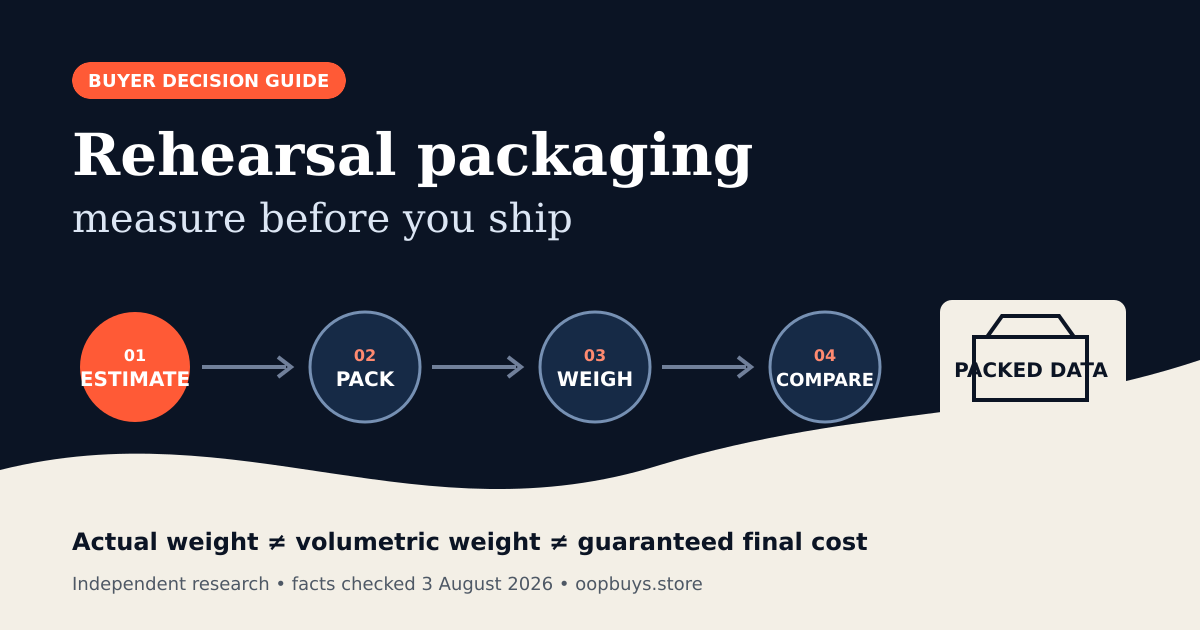
OOPBuy rehearsal packaging is useful only when a more accurate packed parcel can change what you do next. The platform’s current warehouse-services notice describes it as a request for the actual parcel weight before a parcel order is submitted. Staff pack the selected items, weigh the result and inform the user; the table lists CNY 20 per parcel. OOPBuy’s public rehearsal flow also describes the completed result as a final chargeable weight that includes packaging and carrier rules.
That is more specific than adding the weights shown on product pages. Those product-page figures are explicitly estimates, while a loose warehouse item has not yet acquired its final outer carton, protection and packing arrangement. Rehearsal closes part of that information gap. It does not prove a delivery date, customs outcome, insurance result or final route availability, and it does not automatically reduce the chargeable weight. Think of it as paying for a better measurement before committing to international shipping.
Know what OOPBuy currently publishes
The public value-added-services table checked on 3 August 2026 separates three services buyers often confuse. Rehearsal packing is listed at CNY 20 per parcel and is meant to provide the packed weight before parcel submission. Parcel photos are listed at CNY 5 per parcel and include one image before sealing and one after sealing. Detailed product photos are listed at CNY 1 each, either requested with the order or after warehouse intake. These prices are published table values, not permanent promises; confirm the live account price before payment.
The same notice places assembly, parcel consolidation, custom bags or boxes, logo application and similar work under customized warehousing with pricing upon inquiry. That matters because a complicated instruction is not necessarily included in a basic rehearsal fee. If you need shoe boxes removed, fragile pieces separated, a custom carton, vacuum packing or special reinforcement, state the requirement and confirm whether it changes the service charge. A rehearsal result is only useful when it reflects the packaging plan you intend to ship.
Rehearsal, parcel photos and detail photos solve different problems
Choose the service by the uncertainty you need to remove. If the question is whether a label, measurement, seam or defect is acceptable, request a detailed product photo while the after-sales decision is still open. OOPBuy’s fine-photography notice says ordinary inspection generally provides three views—front, back and side or logo—whereas detailed photography follows a specific angle or position request. A packed-parcel service cannot replace product-level QC evidence.
If the question is how the items and protection sit inside the outgoing box, parcel photos are the closer match. The published service provides an image before sealing and another after sealing, but two views still cannot establish every hidden layer. If the question is whether the packed weight changes the route or budget decision, rehearsal packing is the relevant tool. Buying all three by habit creates fees without necessarily improving the decision; buy the smallest evidence set that answers the actual risk.
Understand actual, volumetric and chargeable weight
International lines may compare scale weight with a dimensional or volumetric calculation. The exact formula and divisor depend on the route, carrier and measurement rules, so a universal divisor should not be assumed. A useful model is: volumetric weight equals length × width × height divided by the line’s stated divisor; chargeable weight is normally the greater eligible value after that line’s rounding and packaging rules. Always use the route’s current terms.
A five-kilogram compact carton may still be billed near five kilograms. A two-kilogram parcel with a large shoe-box footprint can be billed much higher if volumetric weight controls. Rehearsal can improve the packed inputs, but it cannot make a bulky object compact by measurement alone. The value appears when you can use the result to change packaging, split or consolidate items, or choose between eligible routes. Record both packed weight and dimensions when the interface provides them; weight without size is incomplete for volumetric decisions.
When the CNY 20 fee can be rational
The strongest case is a parcel near a route threshold or a budget ceiling. Suppose your estimate sits just below a carrier limit. Packaging and rounding could push it over, removing the preferred line or changing the price band. A measured result can prevent a failed plan. The same logic applies to several shoe boxes, puffer jackets, large plush items or protective packaging: the scale weight may look harmless while carton volume drives the bill.
Rehearsal can also help before comparing a split shipment with one consolidated parcel. The right question is not whether one parcel always costs less. Two parcels create two minimum charges and two sets of packaging, while one large parcel can cross a size or route limit. If the plausible difference between options is much larger than CNY 20, better information may be worth buying. If every reasonable outcome leads to the same route and the same action, the fee has little decision value.
When rehearsal is probably unnecessary
Skip it when the parcel is small, compact, well inside route limits and your budget has enough margin for normal packing variance. It is also weak value when you have not finished QC or have not decided which items to keep. Packing goods that may still be returned can complicate the sequence, and OOPBuy’s public flow says selected items are disabled while packing is in progress and the operation cannot be cancelled at that stage.
Do not use rehearsal as a substitute for checking restricted-item rules. Batteries, liquids, magnets, branded goods, unusually long objects and other categories can change eligible lines independently of weight. A precise number is not permission to ship. Likewise, do not buy rehearsal solely because the first calculator estimate feels high. First verify item quantity, unit weight, dimensions and destination; a wrong input remains wrong even when the later process is more precise.
Write packaging instructions that produce a useful result
A vague note such as ‘make it cheap’ is not a packing specification. Identify which items belong in the rehearsal parcel and what can change: remove only packaging you have decided you do not need, preserve tags or sealed boxes where returns or product protection matter, state whether vacuum packing is acceptable, and identify fragile, crushable or moisture-sensitive pieces. If an instruction may be treated as custom warehousing, ask for the quote before assuming it is covered.
Use one consistent plan from rehearsal to final submission. If you rehearse with boxes removed and then request them back, or add reinforcement after the measurement, the reported result no longer represents the shipped parcel. Save the item list, selected packaging options, result screen and timestamp. The record helps you compare like with like and explain any later difference, but allow for carrier remeasurement and route-specific rounding rather than treating the preview as an immutable invoice.
Compare the result without chasing a false precision
After completion, reopen the eligible route list instead of comparing the new number with an old screenshot. Prices, lines and restrictions can change. Check destination, parcel category, packed weight, dimensions, billing increment, route maximums, insurance options and any remote-area or handling charges shown. A route with a lower first price is not automatically better if its limits or protection are unsuitable.
Calculate a range, not a single perfect total. Use the rehearsal weight for the lower-information gap you have removed, then keep a buffer for route pricing, optional services and carrier remeasurement. If volumetric weight is higher than actual weight, focus on dimensions; if actual weight controls, removing a light cardboard box may save less than expected. The result should guide one decision—ship, repack, split, consolidate or wait—not create confidence that every downstream cost is fixed.
Three buyer situations
Buyer A has two pairs of shoes in retail boxes and a light jacket. The parcel estimate is close to a route’s size threshold. Rehearsal with a confirmed box-removal instruction can reveal whether the preferred line remains available; parcel photos can document the packing if box protection matters. Buyer B has one compact sweatshirt far below every threshold. The outcome will not change the route, so rehearsal likely adds cost without changing the decision.
Buyer C has a camera accessory, a long poster tube and clothing. The problem is not only weight: the long item and product classification may determine routes. This buyer should first confirm eligibility and whether splitting the tube is necessary. Rehearsal becomes useful only after a viable packaging plan exists. These examples show why the service should follow a decision tree, not a habit: identify the constraint, select evidence, then pay only if the result can alter the plan.
A practical rehearsal-packaging checklist
Finish product QC and resolve keep-or-return decisions first. Confirm destination and restricted-item classification. List the exact warehouse items for the parcel. Compare at least two plausible packaging plans and identify the threshold that matters. Ask whether special removal, reinforcement, vacuum packing or consolidation requires a separate quote. Confirm the live rehearsal price and the information the result will show. Submit precise, reversible instructions where possible.
When the result arrives, verify the item list and packaging plan, then record packed weight, dimensions and completion time. Recalculate volumetric weight with each candidate line’s own divisor and rules. Check route eligibility again, compare the delivered-cost range and choose whether to ship, repack, split or consolidate. Use parcel photos only if the condition of the packed box changes the decision. The rule is simple: rehearsal is worth buying when better packed-parcel data can prevent a more expensive mistake than the service fee.
Research record
Source titles are shown for transparency without outbound links. OOPBuy’s pages establish what the platform currently publishes; they are not independent proof of every warehouse or carrier outcome.
- OOPBuy Introduction to Warehouse Value Added Service ProjectsRehearsal-packing purpose and published parcel fee; parcel-photo scope and fee; detailed-photo scope and fee; custom warehousing by inquiry.
- OOPBuy Introduction to Fine PhotographyDifference between ordinary inspection photos and specifically requested detailed photography.
- OOPBuy public rehearsal-parcel flowThe current interface describes packing status, final chargeable weight and the step from a completed preview to parcel submission.
- OOPBuy public product pagesCurrent product pages label item weight and dimensions as estimates and show the warehouse-inspection stage after arrival.