
Start with what the OOPBuy shipping calculator can actually know
OOPBuy product pages separate the purchase into two stages: the item travels from the seller to the warehouse, then a later international shipment moves from the warehouse to the delivery address. Current product pages can show estimated item weight, estimated dimensions and an international-shipping estimate. The official Android listing also describes product-weight estimates and live logistics tracking as app features.
Those fields are useful, but their timing matters. Before the item reaches the warehouse, the platform may be working from seller data, category history or incomplete dimensions. Before consolidation, it cannot know the exact outer carton, removed packaging, protective materials or final arrangement of several items. A calculator fed with preliminary inputs produces a preliminary answer. Use it to decide whether an order is broadly affordable, not to promise yourself a final invoice.
Keep the three cost layers separate
A low product price does not describe the delivered cost. First comes the item price. Second may come domestic shipping from the seller to the OOPBuy warehouse; current product pages explicitly show that this seller-to-warehouse charge can apply. Third comes international parcel shipping after warehouse intake and consolidation. Optional warehouse services, packaging choices, insurance and destination taxes can sit around those stages.
Write the layers on separate lines before comparing finds. This prevents a common spreadsheet mistake: judging two products by listed price while ignoring that one has domestic freight, a bulky box or a restricted shipping category. Coupons can change the amount payable, but they do not change the parcel’s physical weight, dimensions or route eligibility. Apply discounts only after the underlying shipping comparison makes sense.
Use better inputs before asking for a better estimate
At minimum, choose the correct destination country or region and use the most realistic weight available. If dimensions are available, keep them. Note whether you plan to retain retail boxes, combine several orders, add reinforcement or remove disposable packaging. Flag batteries, liquids, magnets, oversized shapes and other sensitive characteristics because the cheapest general route may not accept them.
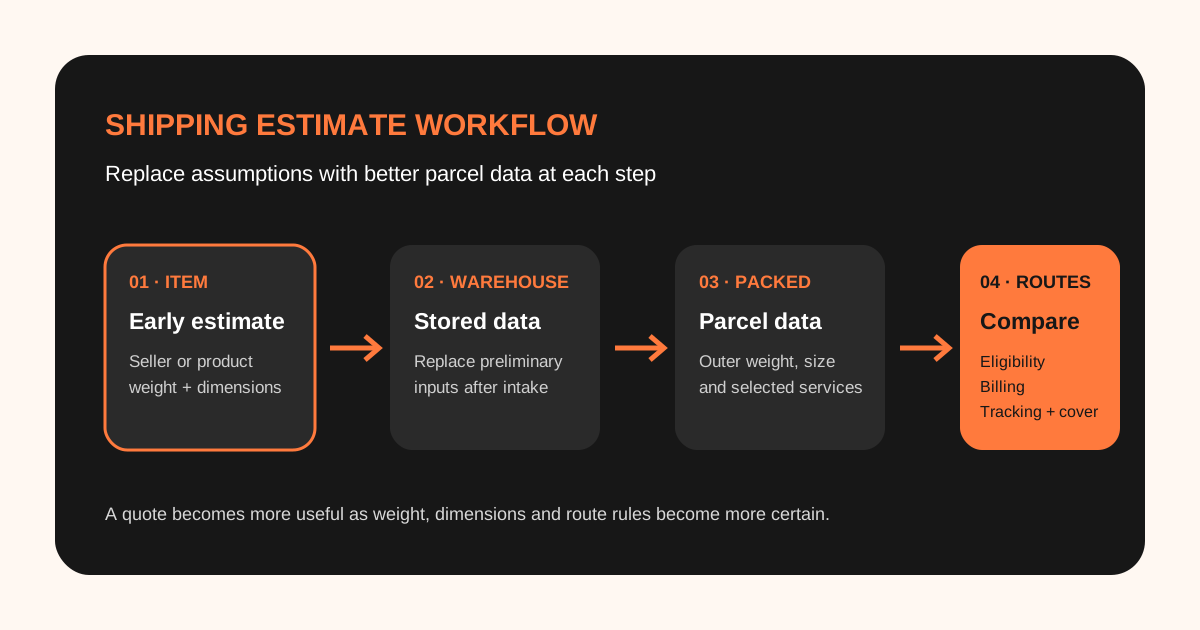
Do not copy the weight of a similar-looking product and treat it as exact. A hoodie can differ by fabric and size; shoes can differ by sole, box and accessories. When the item is stored, replace the early estimate with warehouse data. When the parcel is packed, replace item-level data with parcel-level data. Each later measurement should reduce uncertainty rather than merely confirm the number you hoped to see.
Understand actual weight, volume and chargeable weight
Carriers need to account for both mass and the space a parcel occupies. A compact metal item can be heavy for its size, while a light puffer jacket or shoe box can occupy a large volume. Depending on the selected line, billing may use actual weight, a dimensional or volumetric calculation, or the greater of the two. Lines can also round into billing increments.
The familiar dimensional expression is length × width × height divided by a carrier divisor. Do not insert one universal divisor into every OOPBuy estimate. The divisor, measurement unit, rounding step and applicable rule belong to the specific route. Read the live route detail shown for your destination and packed parcel. If a guide publishes one formula as if it governs every line, it can create false precision.
Why estimated weight and packed weight can differ
Item estimates and parcel measurements answer different questions. Item weight may exclude or approximate seller packaging. The warehouse may receive a box, tags, accessories or protective material that was not represented in the listing data. Consolidation adds an outer carton and any selected protection. Removing a shoe box can lower volume, while corner guards, bubble wrap or a stronger carton can raise it.
OOPBuy’s parcel tutorial says the first parcel payment is estimated and the actual shipping cost becomes payable in “My Shipments” after packing. That distinction is more useful than arguing over whether every estimate should match. Budget a margin, then look for the packed measurements and final eligible-line list. If a large difference remains unexplained, check the dimensions, billing method and selected services before submission.
When rehearsal packing is worth considering
OOPBuy’s published warehouse-services table lists rehearsal packing at CNY 20 per parcel. Its purpose is to provide actual packed weight before the parcel order is submitted. That can be useful when the early estimate is dominated by uncertain volume, when several boxed items are being consolidated, or when two routes have close eligibility thresholds.
Rehearsal packing is not an automatic discount. Paying for better data can prevent a poor decision, but the service does not guarantee a lower rate. Ask first whether the uncertainty could change the route or whether a packaging instruction could materially change the parcel. OOPBuy lists parcel photographs separately at CNY 5 per parcel, described as images before and after sealing. Photos document the package; rehearsal data is for shipping comparison. Choose the service that answers the question you actually have.
Compare eligible lines, not headline prices
Once packed data is available, remove every route that does not accept the contents or destination. Then compare the remaining lines on the same parcel data. A useful comparison includes the billing basis, chargeable weight, rate, tracking level, estimated transit range, compensation conditions and restrictions. OOPBuy’s insurance information directs users to the compensation standard attached to each line, so an “insured” label should never replace reading the line-specific cap and exclusions.
| Check | Why it changes the decision |
|---|---|
| Eligibility | The route must accept the item type, address and parcel size. |
| Billing basis | Actual, volumetric or rounded chargeable weight can change the price. |
| Tracking | Update frequency and final-mile visibility vary by service. |
| Compensation | Caps, exclusions, evidence and claim timing are line-specific. |
| Transit estimate | It is an expectation, not a guaranteed delivery date. |
A practical pre-submit calculator checklist
- Confirm the destination country, region and full postal code.
- Use stored-item data instead of seller estimates whenever available.
- Decide whether retail packaging stays or goes before comparing volume.
- Record batteries, liquids, magnets, oversized shapes and other restrictions accurately.
- Choose any reinforcement or waterproofing before relying on final dimensions.
- Use rehearsal packing when better packed data could change the route decision.
- Compare only eligible lines and read their billing increments and compensation terms.
- Keep a margin for adjustments, currency movement and destination charges.
- Save the packed measurements, chosen route, declaration and payment record.
This checklist is intentionally conservative. It does not promise the cheapest shipping, because the cheapest valid choice depends on contents, destination and risk tolerance. It does reduce the chance of comparing an early quote from one set of assumptions with a final charge built from another.
Common mistakes that make shipping look unpredictable
The first mistake is entering only total item weight while ignoring dimensions. The second is comparing a route before the parcel is eligible for it. The third is assuming that removing packaging always helps; it may reduce volume, but fragile goods can require protection. The fourth is spending a coupon first and asking whether the route is sensible later. The fifth is treating a transit estimate as a delivery guarantee.
Another mistake is waiting too long to separate bad items from the parcel. OOPBuy advertises 90 days of free storage, but storage time is not the same as the shorter after-sales window discussed in the site’s QC and shipping checklist. Review QC promptly, resolve returns, then calculate the parcel using only goods you intend to ship. Clean inputs begin before the calculator.
The most reliable estimate is a sequence, not a single number
Use the product-page estimate to screen an order. Use warehouse weight to refine the plan. Use packed dimensions to compare eligible lines. Use the final shipment record as the amount that matters. At each stage, replace assumptions with better evidence and keep the cost layers separate.
That sequence also explains why two honest estimates can differ. They may have been calculated at different times with different packaging, dimensions or route rules. The goal is not to force the first number to survive every later step. The goal is to make the next decision with the best available data, while understanding what remains uncertain.
Research record
Source titles are shown for transparency without outbound links. Product, category and search actions on this site lead only to the main catalog.
- OOPBuy Product Details and International Shipping EstimateCurrent two-stage purchase flow, estimated item weight and dimensions, domestic freight notice and international estimate fields.
- OOPBuy Android App ListingPublic feature description for product-weight estimates and live logistics tracking.
- OOPBuy Parcel TutorialPublished distinction between the initial estimated parcel payment and actual shipping after packing.
- OOPBuy Warehouse Value-Added ServicesPublished entries for CNY 20 rehearsal packing and CNY 5 parcel photographs.
- OOPBuy Shipping EstimatorCurrent destination- and parcel-input route comparison.
- OOPBuy Insurance and CompensationDirection to use compensation conditions attached to each shipping line.
- OOPBuy Storage PolicyCurrent public statement of 90 days of free warehouse storage.