
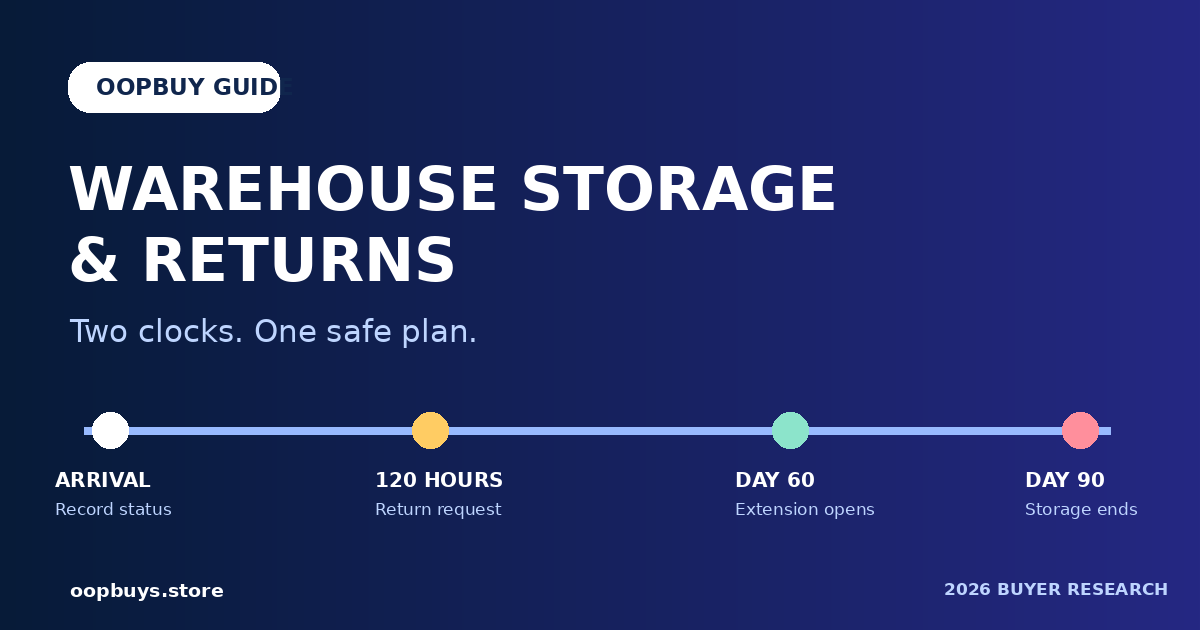
Two clocks start at the warehouse, not one
The most useful way to plan OOPBuy warehouse storage is to separate the after-sales clock from the storage clock. OOPBuy’s current returns notice describes a five-day guarantee as a request made within 120 hours after the order changes to “Stocked in.” The platform says timing begins in the next hour. Its storage notice, by contrast, gives normally received goods 90 days from the “received” status. Ninety days answers how long an item can remain; it does not extend the time to challenge the purchase.
Imagine that a jacket arrives on Monday. The first decision is not when to build an international parcel. It is whether the jacket matches the ordered size, colour and visible condition while a return may still be possible. Waiting two weeks for the rest of a haul can preserve storage time yet lose the shorter remedy. Put both deadlines beside every order: a precise after-sales deadline and a later storage deadline.
| Published rule | What you will learn |
|---|---|
| Return request | Within 120 hours after “Stocked in”; seller agreement and eligibility still apply. |
| Normal storage | 90 days from “received”; no waybill or feedback after expiry can be treated as abandonment. |
| Abnormal unmatched parcel | 30 days from “signed for”; reminders may not be possible. |
| Storage extension | CNY 10 per product ID/month, requested during days 60–90; maximum total storage six months. |
| Card refund arrival | Published estimate of 7–15 days after refund confirmation, depending on the bank. |
Start the 120-hour review as soon as QC appears
Open the warehouse record promptly and compare it with the original order. Check the selected variant, quantity, obvious damage, logos or details important to the purchase, and whether accessories or retail packaging are present. OOPBuy says ordinary inspection generally produces three photos—front, back and side or logo. Those views may be enough for a straightforward item, but they cannot prove hidden construction, authenticity, fit or every measurement.
If a decision depends on a seam, label, sole, connector, measurement or surface defect, request the needed view immediately. The warehouse-services notice lists detailed photos at CNY 1 each. Give a precise instruction rather than “take more pictures.” For example: photograph the size label flat, measure the insole heel to toe, or show the scratch beside a ruler. Extra evidence is valuable only if it arrives before the return decision expires.
Do not ask for tags, packaging or accessories to be removed while you are still deciding. The published exclusions include items whose packaging, tags or accessories were removed at the user’s request. A volume-saving instruction can therefore conflict with return eligibility. Resolve accept-or-return first; optimize the retained parcel second.
Eligibility is conditional, not automatic
OOPBuy’s notice lists three headline conditions for the five-day guarantee: the seller supports returns, the goods remain resalable, and storage has not exceeded five days. It also says a return or exchange proceeds only when the seller agrees. This makes “request submitted” different from “return accepted.” Keep screenshots or records of the order option, warehouse status, QC evidence and the explanation sent to support.
Published exclusions include customized goods, opened sealed items with special standards, subscriptions or newspapers, second-hand goods, items outside mainland China, underwear, adult products, food and seller-specific non-returnable products. The list matters before purchase. If a product type or seller terms make return uncertain, do more source checking and assume the warehouse is an inspection point—not a guaranteed escape hatch.
Who pays depends on why the item goes back
Separate a change-of-mind return from a seller-caused problem. OOPBuy says customer-reason returns normally leave the buyer responsible for transport and service costs. If the seller sent the wrong product or the goods have a quality problem, the published policy generally places the cost away from the customer, although it warns that some sellers may still insist on shipping charges. Document the mismatch clearly enough for that distinction to be reviewed.
The first return or exchange operation in each calendar month is described as exempt from OOPBuy’s service fee, not from shipping. For additional unconditional returns, the notice lists transport back to the seller, seller-to-warehouse freight and a CNY 5 service fee. An additional exchange can involve return freight, two seller shipping trips and the same fee. Even an original “free shipping” order may require repayment of the seller’s dispatch cost. Ask for the expected breakdown before approving a marginal return.
Use a cost test before returning a low-value item
A return can be logically correct but economically poor. Compare the refund expected from the actual product price paid with every non-refundable cost: domestic freight, possible seller charges, service fee after the monthly exemption, and the value of time lost while another item is ordered. Do not include a coupon’s headline value unless the policy confirms it returns in usable form.
For a CNY 45 accessory, two domestic trips and a service charge could consume much of the benefit. For an expensive wrong-size coat, return costs may be proportionally small. The decision is not “cheap item versus expensive item”; it is expected recoverable value versus expected cost and uncertainty. If a seller-caused error is well evidenced, state that reason accurately rather than selecting a convenient category.
Refund confirmation and card arrival are different events
OOPBuy says the refund amount is based on the actual product price paid. After a refund is confirmed, the platform states that it initiates the refund immediately. For bank cards, its current estimate is seven to fifteen days for the money to arrive, depending on the bank. A warehouse return, seller acceptance, refund confirmation and bank posting are four separate milestones; treating them as one date creates avoidable confusion.
Record each milestone and follow up on the missing one. If the seller has not received the return, the issue is logistics. If OOPBuy has not confirmed the refund, it remains a platform or seller-resolution step. If confirmation exists but the card has not posted, the bank estimate becomes relevant. Never write a guaranteed refund date into a budget.
Consolidate only goods you have decided to keep
Parcel consolidation can reduce duplicate outer packaging and lets several stored purchases travel together, but it should come after QC and after-sales decisions. OOPBuy’s warehouse-services notice places consolidation within custom warehousing, with pricing upon inquiry. That wording is not a universal fixed fee. Ask what work is included when a request is unusual, and do not assume every packaging instruction is reversible.
Build a consolidation group by destination, route restrictions, fragility and deadline—not merely by arrival order. Batteries, liquids, magnets, oversized cartons or high-risk goods can narrow eligible lines. A heavy compact item and a light bulky item can also change chargeable weight when packed together. Use the site’s shipping calculator guide after the keep list is final, then decide whether rehearsal packing is useful for uncertain dimensions.
The warehouse is a staging area, not a reason to postpone every decision. Resolve questionable products first. Then remove unwanted retail packaging only from retained goods, select protection, and compare routes on the packed parcel rather than on a basket total.
Know the 90-day storage rule and the exception
For normal goods, OOPBuy publishes 90 days of free storage from “received” status and says the system emails users as expiry approaches. If no waybill is submitted and no feedback is given after 90 days, the goods are treated as abandoned and may be disposed of. Do not make the reminder your only control; account emails can be filtered, contact details can change, and several items can have different start dates.
Unmatched abnormal packages use a different rule. The storage notice gives them 30 days from “signed for,” explains that reminders may be impossible, and says they can be treated as abandoned or destroyed after expiry. This can apply when a package cannot be linked cleanly to an account or order. Preserve domestic tracking and submit any required delivery information so the warehouse can match the parcel.
Perishable or shelf-life limits are another boundary: the storage policy says responsibility does not cover those natural expiry constraints. A nominal 90-day period does not make a time-sensitive product suitable for long holding.
Extend storage deliberately, not at the last minute
OOPBuy’s value-added-services table says extension is available only for goods stored between 60 and 90 days. It lists CNY 10 per product ID per month and a maximum total storage time of six months. The general storage notice also describes CNY 10 for 30 days. The product-ID basis matters: ten different IDs can cost more than ten units grouped under one ID.
Use extension when the saved international parcel, coordinated purchase or delayed destination genuinely justifies it. At roughly day 55, audit every item. At day 60, decide whether to ship, return only if still independently eligible, extend, or abandon intentionally. Waiting until day 89 leaves little room for payment, support review or a status mismatch. Keep confirmation of an approved extension and calculate the new deadline yourself.
A deadline-safe warehouse checklist
On arrival day, record the stocked-in time and the received date. Within the first day, compare variants and QC images. Request only decision-relevant photos. Before 120 hours, choose keep, exchange or return and preserve packaging until that choice is settled. If returning, confirm seller acceptance, reason, expected freight and service fees. Track the parcel back to the seller, refund confirmation and payment-method arrival separately.
For kept goods, group only compatible items, decide packaging and protection, and estimate the final parcel with realistic dimensions. Review all storage ages weekly. Audit at day 55; decide on extension from day 60 rather than at expiry. Keep domestic tracking for unmatched parcels and never rely solely on an email reminder.
This process cannot guarantee that a seller accepts a return or that a refund posts on a particular day. It does turn published limits into visible decisions. The central rule is simple: inspect on the short clock, consolidate on the long clock, and never use 90-day storage as a substitute for the 120-hour after-sales window.
Research record
Source titles are shown for transparency without outbound links. OOPBuy’s own notices establish what the platform publishes; they are not independent proof of every outcome.
- OOPBuy Returns and RefundsEligibility, exclusions, 120-hour request window, seller agreement, cost responsibility and bank-card timing.
- OOPBuy StorageNormal 90-day storage, 30-day unmatched-package rule, abandonment handling and extension description.
- OOPBuy Warehouse Value-Added ServicesStorage-extension timing, CNY 10 per product ID per month, six-month maximum, detailed-photo price and custom warehousing.
- OOPBuy Fine PhotographyPublished difference between ordinary three-view inspection and requested detail photography.